


There’s something deeply unsettling about a dark hallway that should not be dark.
Not a haunted castle or a monster-filled dungeon. Just a hallway. A yellow room. A flickering fluorescent light. A children’s cartoon that goes on a few seconds too long. A local TV station interrupting the broadcast with something that feels official, but wrong.
That’s the strange power of analog horror.
For the uninitiated, it’s a style of internet horror built on the aesthetics of old VHS tapes, emergency alerts, public access television, and found footage — think Local 58, The Mandela Catalogue, or The Backrooms. It doesn’t lean on jump scares. It leans on atmosphere. Degraded, distorted, half-remembered, and incomplete.
A demon jumping at the screen scares you for a second. A low-quality tape recovered from a locked basement follows you around for days.
Analog horror isn’t scary because something bad might happen. It’s scary because something is wrong with the world.
And Christians already believe that.
Analog horror almost always begins with something familiar being interrupted. A broadcast cuts out. A safety announcement starts revealing something terrifying. The medium itself becomes part of the horror.
That’s closer to Christian theology than it might first appear.
Scripture presents creation as good, but not untouched. Sin has entered the system. The signal is still there — beauty, love, grace — but there’s static now. Corruption, fear, death, and decay bleed through.
Analog horror puts that feeling on a screen. It asks, This was supposed to be safe. So why does it feel so wrong?
That’s a deeply human fear. It’s also a deeply biblical one. We were made for Eden, but we live east of it.
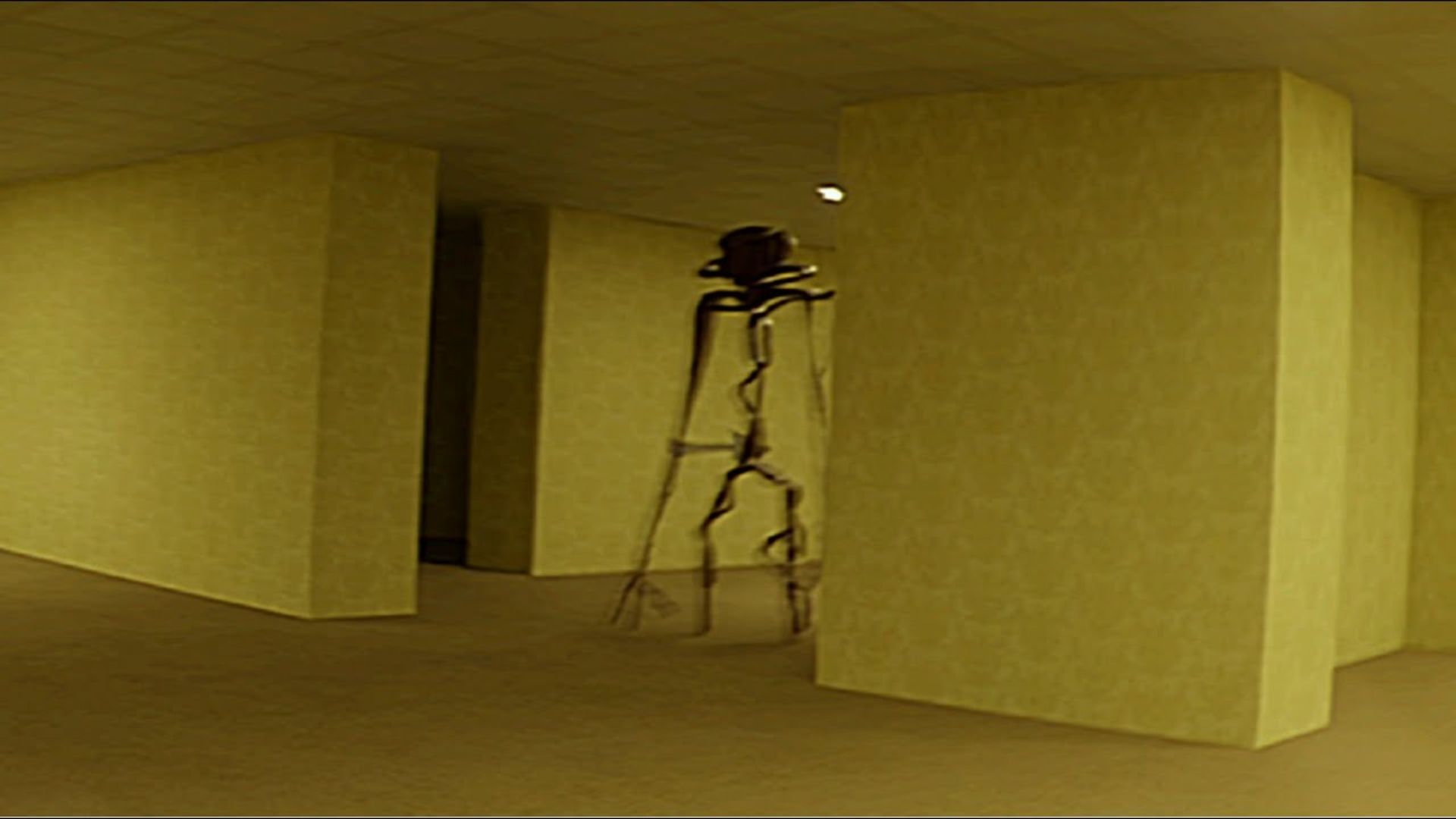
The Backrooms are terrifying in a way that’s hard to explain. It’s not that they’re scary — it’s that they’re almost familiar. The wallpaper looks like an old office building. The carpet looks like somewhere you walked through as a kid. It’s nostalgia with the soul removed.
That’s the language of liminal spaces. Places of transition. Places you pass through, but don’t belong in. Empty them out, stretch them forever, and suddenly they feel like a world that forgot what it was for.
Christians should understand this. In a sense, the entire Christian life is lived in a liminal space. We are saved but not yet fully restored. Citizens of heaven, still paying bills on earth, still grieving, still waiting. We live in the “already” and the “not yet.”
The Backrooms aren’t just scary because you might be lost. They’re scary because you might be trapped in a place that was only supposed to be temporary.
Deep down, all of us are afraid of that.
One of the creepiest things about analog horror is how often it speaks in the voice of authority. Emergency alerts. Government warnings. Corporate training videos. The voice is calm. Official. Confident.
And then it tells you something horrifying.
“Do not look at the moon.” “Everything is fine.”
Christians shouldn’t be surprised by this fear. Scripture is full of warnings about false shepherds, wolves in sheep’s clothing, and voices that sound persuasive but lead people away from truth. Analog horror asks, What if the thing telling you how to survive is actually leading you to destruction?
That’s not just a scary premise. That’s a spiritual warning.
Discernment matters. The voice you follow matters.

Modern horror explains too much. Analog horror gives you fragments — a distorted frame, a symbol, a face in the dark that might not have been a face at all. It suggests there is more going on than you can see, and that the full picture may be too large or too terrible to understand.
Christians live with a similar belief, though not a hopeless one. We believe reality is bigger than the visible world — angels and demons, sin and grace, a Kingdom of darkness and the Kingdom of God.
Analog horror twists that belief into dread. It imagines an unseen world that is cold, hostile, and unknowable. Christianity says the unseen world is real — but not ultimate chaos. There is darkness, yes. But there is a King over it.
Analog horror taps into the fear that reality is bigger than we thought.
Christian hope says, Yes. But Christ is bigger still.
Part of it is curiosity. Part of it is the fun of being scared in a controlled environment. But I think there’s something deeper.
Analog horror gives shape to fears we don’t always know how to name. The fear that the world is broken. That home is gone. That trusted voices are lying. That we are lost. That something is wrong, and no one else seems to notice.
Christians don’t need to pretend those fears are silly. The Bible doesn’t offer a plastic-smile version of reality. It tells the truth about darkness, death, deception, and the ache of living in a world that is not as it should be.
But it also tells us something analog horror usually doesn’t.
There is a way out.
There is a Shepherd in the valley of the shadow of death. There is a Light the darkness has not overcome. There is a home that is not temporary. There is a Kingdom that cannot be hijacked by static.
Analog horror resonates because it tells us something is wrong.
Christianity resonates because it tells us that wrongness is not the end of the story.
The signal may be full of static.
But the Light is still breaking through.
Love what you just read? Get more LTN!

Related Content

Save & Continue 22 | The Law of Hospitality

CBG 52 | Rolling Dice, Fighting Fear & Trusting God

Bible Thump 182 | Every Season of Life Has a Purpose (w/ Aki)

CBG 49 | It’s a Wonderful World (Season 5 Finale)

Save & Continue 13 | The Fictophilia Conversation (w/ LenLenRabbit)

What Fan Hatred of Rings of Power Teaches Us about the Bible


Reader Comments