


Galadriel wasn’t a soldier, Gandalf didn’t arrive in the Second Age, Harfoots didn’t travel, and why did they make Tom Bombadil mean!?
These are but a few of many, many crimes committed by Amazon’s Lord of the Rings prequel series, The Rings of Power. For many, the scrutiny and skepticism started before the series was ever developed. Even when the second season came out two years later and was better received by general audiences and critics, it seemed to me, a bona fide Lord of the Rings fan, that bashing Rings of Power remained a badge of honor for many online.
To be sure, there are many valid criticisms of the series.
Season one suffered from poor pacing and lackluster storytelling. The whole arc could’ve been shown and explained in half the time. The dialogue itself felt lackluster. Lines clearly meant to be impactful such as “Sometimes to find the light, we must first touch the darkness” and “True creation requires sacrifice” felt empty and contrived.
there is one specific critique that rears its ugly head whenever a beloved book is translated to a new medium that I’ve come to believe should be dismissed from good-faith discussions: “That wasn’t in the book.”
The series also clearly desired to attach itself to the success of Peter Jackson’s film trilogy despite actually being a separate story in a shared universe. They hired Oscar-winning Lord of the Rings composer Howard Shore to compose the series’ theme, cast actors who had a passing resemblance to their film counterparts, and even took inspiration from the props used in the film (Rings of Power’s Narsil, Elendil’s blade, looks suspiciously similar to Return of the King’s Anduril, forged from the fragments of Narsil for Aragorn).
However, there is one specific critique that rears its ugly head whenever a beloved book is translated to a new medium that I’ve come to believe should be dismissed from good-faith discussions: “That wasn’t in the book.”
After all, does a film or show have to be faithful to its literary counterpart in order to be a quality piece of art or entertainment? If so, then why do fans laud film adaptations like Dennis Villenueve’s Dune, Tim Burton’s Big Fish, and even Peter Jackson’s the Lord of the Rings when all three made deliberate departures from original source material?

Maybe adaptations can actually change or even improve the story put forth in the original.
After all, no book is perfect, right? Well, maybe one.
Christians believe that the Bible, although written by men, was divinely inspired by God, resulting in an original production that is without error. This belief is called the Doctrine of Biblical Inerrancy.
The Doctrine of Biblical Inerrancy arises from verses like “All Scripture is breathed out by God…” (2nd Timothy 3:16a) and “For no prophecy was ever produced by the will of man, but men spoke from God as they were carried along by the Holy Spirit” (2nd Peter 1:21).
The core idea is that the Biblical authors were not just writing from personal experiences alone, but rather were inspired by God to communicate His divine truth. Therefore, Biblical Inerrancy holds that the original manuscripts used for the Bible are totally true and without error.
After all, no book is perfect, right? Well, maybe one.
As the Bible was copied and passed down throughout history, occasionally minor grammatical and translational errors have inevitably slipped in. While these discrepancies make good headlines for non-believers looking to discredit the Bible they often focus on somewhat trivial mistakes such as numbers of casualties following a battle. Intense study of the wide range of historical copies can reveal where the mistakes in the newer editions occurred.
Though critics of the Bible are quick to find grammatical or translational errors, the New Testament remains the most prolific text that predates the middle ages, with over 5,700 manuscripts. That’s more copies than Homer’s Illiad, Plato’s Republic, Sophycles’ plays, and Tacitus’ Annals combined. Moreover, there is a 99.5% textual agreement across all of the New Testament manuscripts.
The doctrine of Biblical Inerrancy dictates that the Bible isn’t to be added onto or improved, but rather demands believers use Bibles that reflect the original text most accurately based on the remaining documents we have.
So what does all this doctrine and history have to do with the price of Lembas in the Shire?
Essentially, Biblical Inerrancy demands that speech or writing claiming Christianity is only good insofar as it agrees with the Bible. Because if the Bible is our core and perfect source of truth about God and life, to mislead or deviate from that is to deviate from God and His purpose for our lives. Simply put, you can’t improve upon the Word of God.

The apostle John warns of the dangers of editing or adding to inspired, inerrant Scripture, “I warn everyone who hears the words of the prophecy of this book: if anyone adds to them, God will add to him the plagues described in this book, and if anyone takes away from the words of the book of this prophecy, God will take away his share in the tree of life and in the holy city, which are described in this book.” (Rev. 22:18-19).
But can you improve or, at least, change a famous fictional story?
I’d argue that changes, adaptations, and rewrites can, in fact, enhance fan enjoyment and experience without being problematic. The examples listed earlier, Dune, Big Fish, and The Lord of the Rings trilogy, do exactly this. Dune streamlined the story and removed some of the more convoluted textual elements, resulting in a film with broad audience and critical appeal. Likewise, Tim Burton took Daniel Wallace’s more conceptual and abstract short story book and placed it explicitly within a father-son relationship resulting in a story that, once again, an audience enjoyed. Let’s get back to Rings of Power.
I’d argue that changes, adaptations, and rewrites can, in fact, enhance fan enjoyment and experience without being problematic.
Like Peter Jackson before them, ROP showrunners J.D. Payne and Patrick McKay take the main story beats from Tolkien’s works and shove them into a far tighter timeline. Payne and McKay took Middle-earth’s 3,441-year-long Second Age and are (presumably based on the first two seasons) attempting to condense it into a lifetime or two.
Is their gambit ambitious? Absolutely, but the real reason the Rings of Power isn’t earning Emmys is not due to timeline changes but rather suggests the audience isn’t responding well to the series. The success of Rings of Power relies far less on its accuracy than its ability to captivate and endear an audience.
The same is true of the series’ depiction of Galadriel. In Tolkien’s books, and all adaptations up to date, the ancient elven queen and ringbearer has been portrayed almost as a matriarchal prophetess witnessing the events of Middle-earth as they unfold.
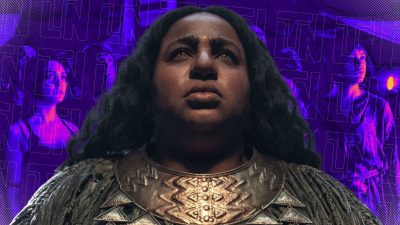
However, in the Rings of Power, she is given a more active role as a military leader and heroine. While fans protested this change, it should be noted that Galadriel is often described as one of the most powerful elves in Middle-earth in the Lord of the Rings. In the Unfinished Tales, Tolkien even describes her as physically strong and capable.
However, many viewers found the writing, or at least Morfydd Clark’s portrayal of Galadriel, alienating and unlikable. She actively ignores the needs and requests of her own soldiers to fulfill a personal vendetta, attempts to command the Queen of Numenor on military matters despite being a mere visitor, and often comes off as smug and condescending towards other characters. While she eventually grows past these traits, the series fails to make clear whether we are supposed to admire or be frustrated by Galadriel.

So the issue with Galadriel in The Rings of Power wasn’t one of accuracy, but the way Galadriel actually came across onscreen.
Finally, the relationship between Prince Durin of Khazad-Dum and Elrond of Lindon is never really detailed in any of Tolkien’s writings. Yet, their friendship was one of the most compelling things about season one. Because Elrond is immortal and cannot appreciate the limits of a normal lifespan, he fails to live up to Durin’s expectation of friendship by going long bouts without checking in on his friend. So, when they meet again in episode two, Durin is fuming at his half-elf friend for years of silence.
As they reconnect, they begin a compelling conversation about the short-comings of immortal life.
None of this is in Tolkien’s work. All of it works well on-screen.
The cardinal sin of The Rings of Power season one was that it failed to endear itself to its audience. Further deviation from Tolkien’s original works doesn’t make the latest edition of Rings of Power less successful. If anything, it is a better show than it was in season one. It managed to pack in more story, drama, and action, making it a far more watchable season.
seeing an old story you love told in a brand new way may be disappointing. But it may also be enlightening. At the very least, it is not heretical.
The goal of an adapted television show or film should not to act as a vehicle for the original story, but rather to be a strong and captivating piece of art on its own, regardless of source materials. No Tolkien movie or television show will ever be a Tolkien novel. They’re different mediums for a reason.
Obviously, seeing an old story you love told in a brand new way may be disappointing. But it may also be enlightening. At the very least, it is not heretical.
If you give an adaptation the space to breathe and become its own independent work, you may find yourself loving a whole new piece of art. After all, as Anne Hathaway said when asked to compare the 2012 film, Les Misérables, to its 1985 stage musical counterpart, “It’s a different accomplishment.”
Love what you just read? Get more LTN!

Related Content

Save & Continue 22 | The Law of Hospitality

Why Diversity is Good and How Rings of Power Did It Wrong

Watching Your Child Develop Their Own Fandom

Church Nerds 85 | The One about Advent

Church Nerds 84 | Rings of Power


Reader Comments